 Lakshmi
Nina Gold is nothing short of a casting alchemist — the creative force behind some of the most iconic, emotionally resonant ensembles in contemporary film and television. From the sweeping worlds of Game of Thrones and House of the Dragon to the intimate precision of The Crown, The Favourite, and 1917, Gold has an extraordinary gift for finding not just actors, but the exact right humans for every story. Her casting doesn’t simply populate a world — it defines it, shaping how audiences feel, remember, and fall in love with the characters on screen.
After years of shaping ensembles for music videos and commercials, Gold reached a turning point in 1992 when she cast a McDonald’s commercial directed by Mike Leigh. That collaboration laid the groundwork for a lasting creative partnership. Seven years later, Leigh brought Gold on to cast Topsy-Turvy, marking her first major feature film, and since 1999 she has gone on to cast roles in seven of Leigh’s films.
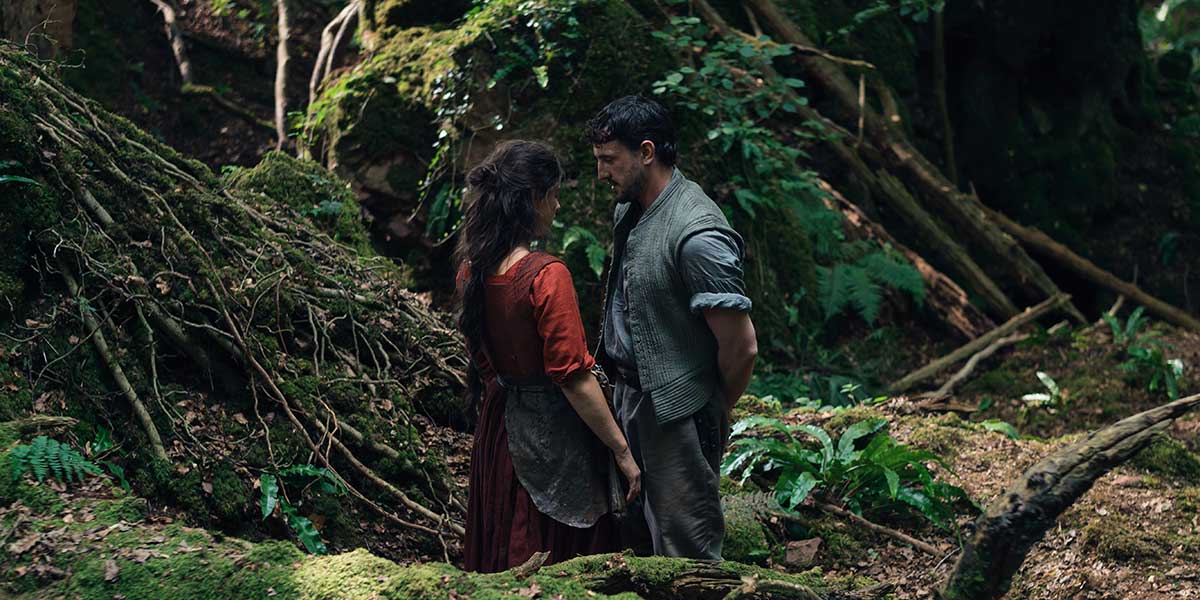
One Lash Shot was thrilled to sit down with Casting Director Nina Gold to talk about her work on Hamnet directed by Chloé Zhao, the TIFF People’s Choice Award–winning film, where her instinct for emotional truth and literary sensitivity shines especially bright. In our conversation, she opens about her intuitive casting process, her close creative partnerships, and how she approached assembling a cast for a story as tender, poetic, and quietly powerful as Hamnet.
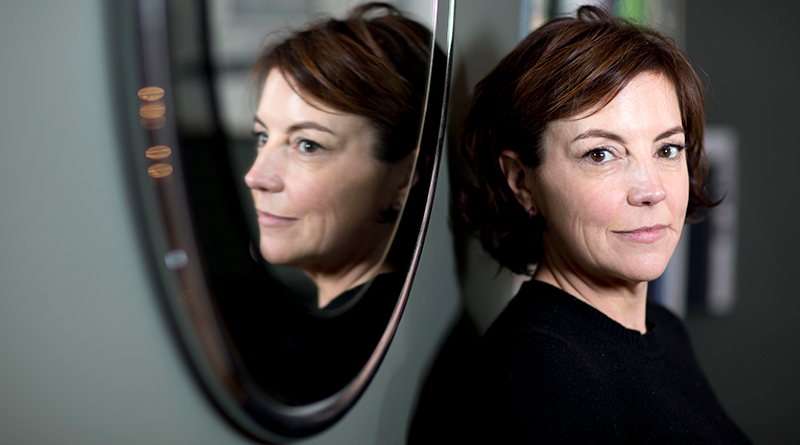
I was so happy to hear that Casting is an official Oscars category this year—how do you feel about that, especially after working on such major projects as Game of Thrones, The Crown, Mamma Mia, and most recently, Conclave?
It’s been pretty great. It’s wonderful. It took a while, but here we are.
Do you have a favourite project among your work?
I mean, that would be like choosing a favorite child, but I mean, today it’s definitely Hamnet.
What made you get into casting in the first place?
I mean, I didn’t really know that casting was an actual thing until I’d been doing it for a while. I kind of knew I wanted to do something in film, but I didn’t know anything about how it worked or how to get a job.
And if I’m really honest, I’m supremely un-technical. Anything involving technical skills just wasn’t my strength, so I realized the thing I had the best chance of being good at was working with people. That’s what I’m interested in — people, character, and how people and story connect.
How closely did you work with Chloé during casting, and what kinds of conversations shaped your decisions?
I mean, we worked very closely. Chloé, who’s obviously a phenomenal director, was keen to say, “Look, the films I’ve made before haven’t really been like this,” because her previous work was mostly with non-actors. So, this was a whole different approach. We were really hand in hand, figuring out a new way for her to approach it.
I like to think she relied on me, too, because I’d been doing a different kind of work in a different country for decades. We each brought our own perspective, and we went through it all together.
How did you end up working on this project in the first place?
The producer, Liza Marshall, is a neighbour and a friend, and we’d worked together a lot, and she’d been talking to me for — well, we’d been talking about it for years, basically, just slowly, little by little. And then she was like, “Okay, we’re going to get Chloé Zhao to direct it,” and I was like, “Wow, this is incredible.”
Did you approach Hamnet more as a literary adaptation or as its own cinematic world when thinking about casting?
I think… we stopped being concerned about the kind of literary or period parts of it and just approached it from a “these are human beings, alive at any time and in any place” perspective. And that was where to start with the kind of universal humanity of the characters. And I think the whole thing is quite stripped back and simplified from the book, which is obviously much more wordy — what with it being a book and everything.
And it was a simplifying process, I think, in a really good way.
Did you audition Jessie and Paul together early on, or did their chemistry reveal itself in a more organic way over time?
We did a slightly crazy chemistry read in my office and just did a lot of improvising and playing, really. And it was very evident after about 20 seconds that they were going to be incredible together.
Looking back, was there a moment — in an audition, meeting, or rehearsal — when you knew unequivocally that Jessie and Paul were “the ones”?
Yeah, I mean, in the first minute of that chemistry read between the two of them, it was immediately clear.
We did film a bit on our phones, but it was really more about working through it in a feeling-driven, improvisational way — just feeling it out and watching it grow.
Agnes is such a complex, interior character — what qualities were essential for you in finding the right actor for her?
I think… Jessie has a lot of what Agnes has — she’s very connected to her natural environment and the earth; she has a real earthy quality.
She really has her feet on the ground, and she’s very much in her body. At the same time, she’s a phenomenal actress. And whereas Shakespeare is obviously more in his head, they have different, almost opposing qualities — but ones that are perfectly matched.
When casting William, how important was it that he feel “ordinary” rather than mythic, especially given how iconic Shakespeare is to audiences?
Paul is someone who has a different kind of interior life — more in his head, or at least he can access that part of himself. That’s hard to play, you know, really hard. But he has this real ability to keep it simple and truthful.
What were the challenges in casting the children—Hamnet (played by Jacobi Jupe), his twin sister Judith (Olivia Lynes), and his older sister (Bodhi Rae Breathnach)—especially in finding young actors who could access their inner emotions in a natural, non-theatrical way?
I mean, casting kids is always challenging — even a little frightening. You really have to do a lot of work. There’s no getting around seeing and trying a lot of kids because you just don’t know. But then, when they appear and show this kind of emotional availability without putting it on, it really makes you sit up and think, “Okay, you’ve got this.” When that happens, it’s just wonderful.
They actually went through a lot of very thorough — and quite grueling — auditions.
What was the most challenging role to cast, and why?
I guess, I mean, the kid casting was definitely the most challenging part. Casting kids is always hard — it’s pretty much uncharted territory, so you’re starting fresh every time. You try a kid, and you really have no idea what they’re going to be like. On top of that, there was the challenge of casting twins. We had to find kids who could plausibly be fraternal twins and also match each other in terms of performance.
How involved were you during the shooting process?
During the shooting process, we hadn’t finished casting, so I was still casting the final roles as we went along — it was all a bit of patching up. I was doing that, but also just visiting everyone, because we all became very, very close.
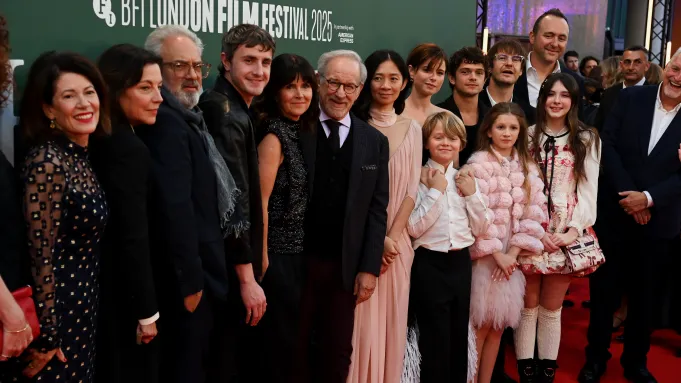
Was there a favorite moment through this movie’s casting process that stood out to you?
Yeah, I mean, I guess the best part was the final audition with Jacobi, Olivia, and Bodhi. We tried them all together, and then we tried them with Paul and Jessie. You know, it was make-or-break — the day when you really find out if it’s going to work or not. And it was amazing.
There was Paul, just standing, and Jacobi walked into the room. Paul walked across, and just picked him up in the air — like that bit in the movie when he whirls him around. And Jacobi was completely in it. I just thought, “Okay, this is going to work.”
What do you hope the audience takes away about the world of casting when they watch Hamnet?
I guess I hope that people get so immersed in the film — in its truthfulness and honesty, and in the way it’s about humanity interlocking and interacting, and how storytelling helps us through life and makes us human — that they’re not thinking about the casting. I hope they find it so compelling that the casting just fades into the background.
What message do you hope the audience takes away?
I guess… it’s really all about love.

 Lakshmi