 Lakshmi
Hannah Bergholm’s feature debut Hatching arrived at the 2022 Sundance Film Festival as a startlingly original piece of body horror, a strange and unsettling fusion of family drama, fairy tale, and creature feature that announced the arrival of a singular genre filmmaker. Her follow up, Nightborn, confirms her fascination with the darker emotional landscapes of family life, though this time Bergholm trades the sharp precision of her debut for something more primal and folkloric.
Nightborn made its world premiere at the 76th Berlin International Film Festival and later earned the Cheval Noir Award for Best Film at the 2026 Fantasia International Film Festival, where Seidi Haarla was also honored with an Outstanding Performance Award for her commanding lead performance. For her English language debut feature, Bergholm draws from familiar horror traditions while grounding the story in Finnish folklore, blurring the lines between maternal anxiety and supernatural terror.
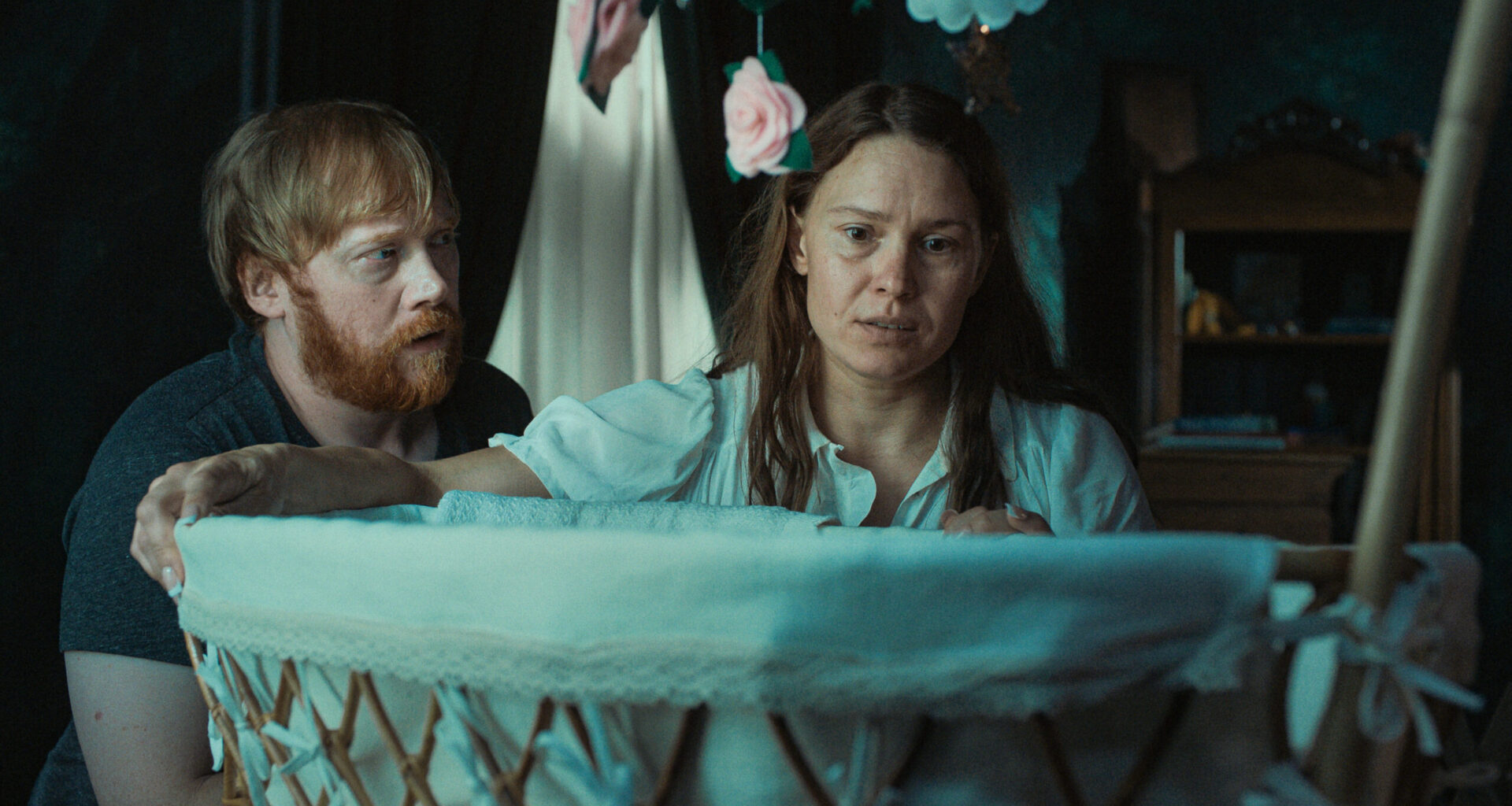
At the center of the film is Saga (Seidi Haarla), who longs to build the perfect family with her husband Jon (Rupert Grint). After the birth of their son Kuura, the couple retreats to a remote Finnish countryside home inherited from Saga’s grandmother, hoping to create an idyllic life surrounded by nature. Instead, the old house, with its decaying walls, oppressive green nursery, and creeping vegetation, becomes a reflection of Saga’s unraveling state of mind.
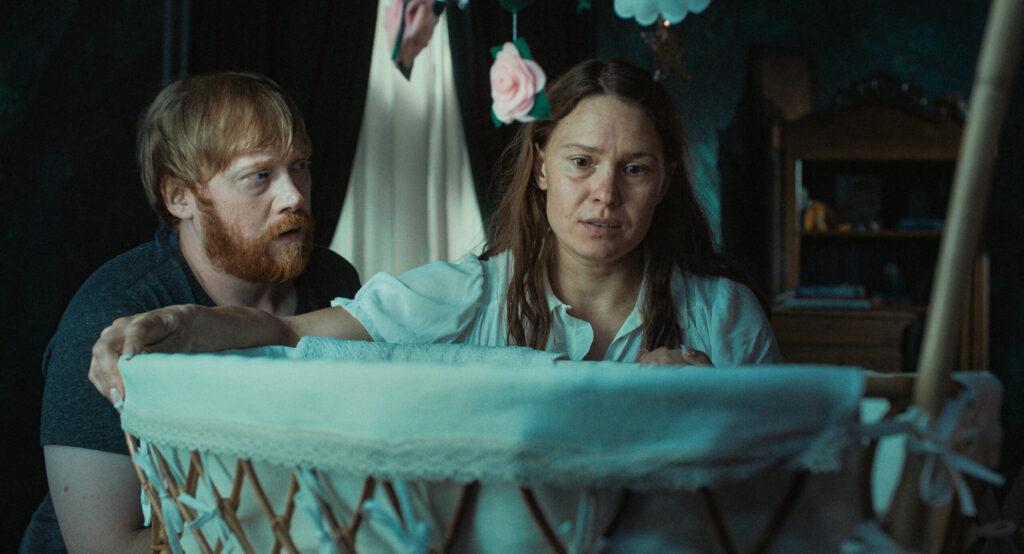
From the beginning, Bergholm signals that something is wrong. The camera approaches Kuura’s crib with unease, keeping the baby’s face hidden while unsettling sounds transform ordinary infant cries into something almost animalistic. The film’s horror emerges not from immediate spectacle but from suggestion: the child’s unnatural development, the hair on his back, his sharp nails, his violent feeding instincts, and his disturbing connection to the forest surrounding the home.
Bergholm’s most effective choice is refusing to fully reveal Kuura as a conventional monster. In an era increasingly fascinated with unusual “little guy” creatures, Nightborn finds terror in restraint. The child is often presented as an ordinary infant, making his impossible behavior even more disturbing. Watching a baby move far beyond his natural abilities or respond to blood and raw meat creates an unsettling collision between innocence and horror.
The film’s greatest strength, however, is its emotional perspective. Bergholm places the audience firmly alongside Saga, whose fear and exhaustion are dismissed by everyone around her as signs of postpartum distress. Her husband Jon, played by Grint with a deliberately awkward warmth, is not a traditional villain but rather a well-meaning man unable to understand the reality unfolding around him. He believes he is protecting his family while simultaneously becoming part of the system that isolates Saga.
Grint’s performance is notable precisely because Jon is not written as a simple antagonist. He is affectionate, confused, and increasingly out of his depth. Following appearances in projects such as Harry Potter, Servant and Knock at the Cabin, Grint continues to build an intriguing second chapter in his career, embracing roles that explore vulnerability beneath ordinary surfaces.
Yet Nightborn belongs to Haarla, whose performance becomes increasingly feral and devastating. Saga’s transformation is both physical and psychological. She is not only fighting a supernatural threat but also confronting the loss of herself within motherhood. The film understands the exhaustion, loneliness, and invisible pressures placed upon new parents, using horror as a heightened expression of very real fears.
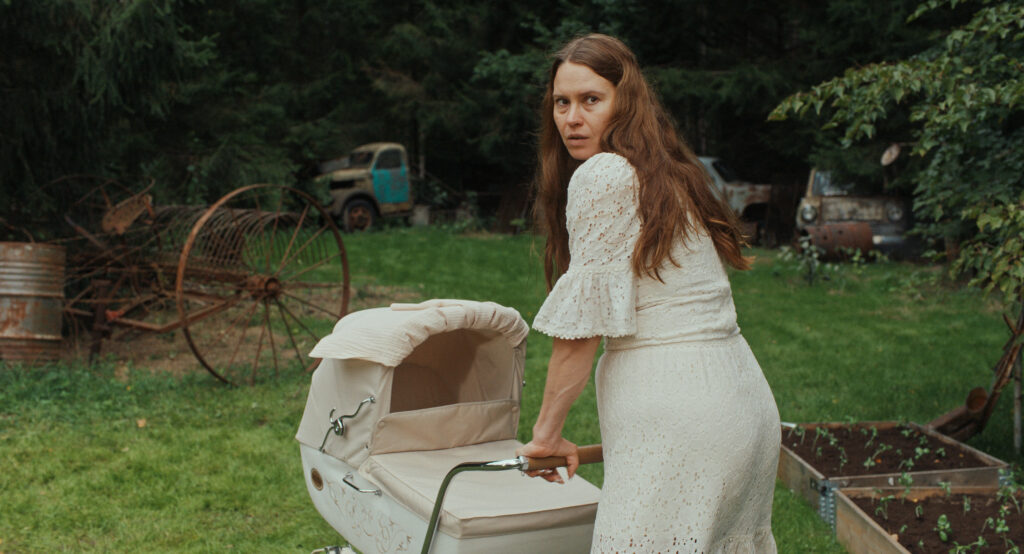
Visually, Bergholm once again demonstrates a remarkable command of atmosphere. The forest is not simply a setting but a living presence, a space filled with ancient mythology and unanswered questions. Cinematographer Pietari Peltola captures the home and landscape as extensions of Saga’s fractured consciousness, while the creature effects, created with the help of Star Wars and Jurassic World animatronic designer Gustav Hoegen, embrace a wonderfully tactile, old school approach to horror.
Like Hatching, Nightborn uses body horror not merely for shock but as a language for exploring transformation, fear, and identity. Bergholm’s distinctive visual language, Haarla’s powerful central performance, and the film’s unsettling folkloric undertones make Nightborn a memorable addition to contemporary maternal horror, leaving behind a lingering sense of unease.


 Lakshmi