
 Lakshmi
If you’re the sort of person who prides yourself on never crying at the movies, consider this film a fairly persuasive argument for surrender. It is the rare kind of emotional ambush that sneaks up on you quietly, only to leave you reaching for a tissue by the final act.
Much of its richness comes from the film’s deep immersion in the culture of Chaoshan, in eastern Guangdong, rendered with an almost tactile specificity: from its traditions and social rhythms to the unmistakable cadence of the Southern Min–derived Teochew dialect. And yet the film remains unmistakably, gloriously Thai in atmosphere: Thailand isn’t merely a backdrop but a living presence, giving the story its particular sense of place, warmth, chaos, and melancholy.
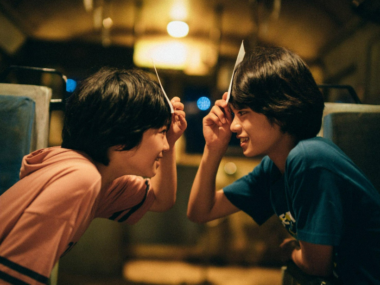
There is a reason for all those tears. At its heart, the film is an achingly tender love story: a boy catches sight of a wealthy young woman carrying a banner during a parade and fate, with a distinctly mischievous sense of humor, takes over. Bhagseng and Sogriu first meet during a Teochew “Ying Laoye” spring parade, when Bhagseng, overcome with nerves, finally works up the courage to approach her. However, he ends up crossing a bridge and tumbles straight into the stream below during the first meet-cute chase.
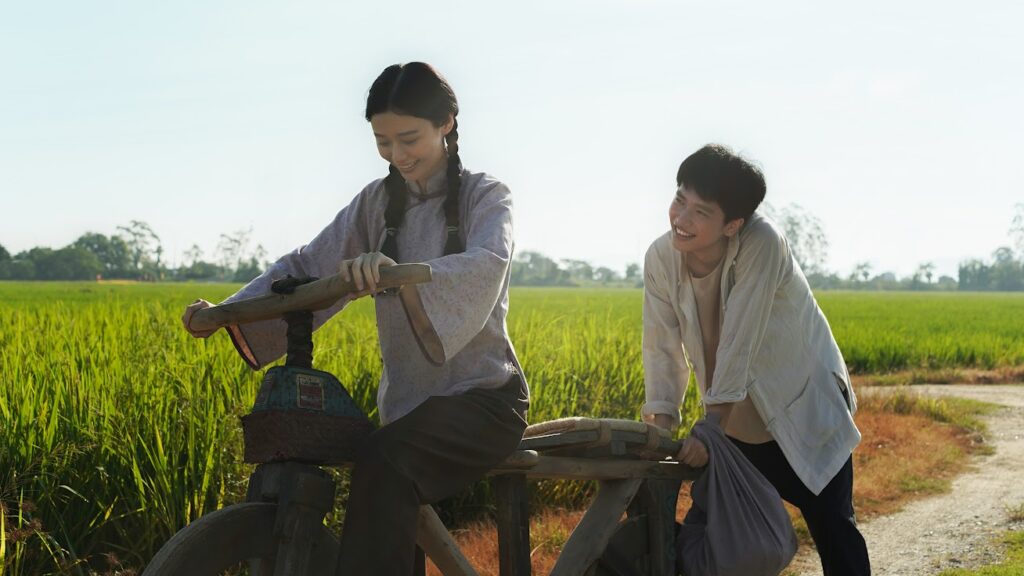
The scene is romantic, ridiculous, and somehow all the more affecting for being rooted in fact. The bridge still stands in Xiqi Village, a farming community in Jieyang, Guangdong, where some 11,400 people live today. It lends the romance an almost cinematic afterlife: what begins as a fleeting encounter between two young people is anchored to a real place, one that has endured long after the moment and the love story it set in motion, has passed.
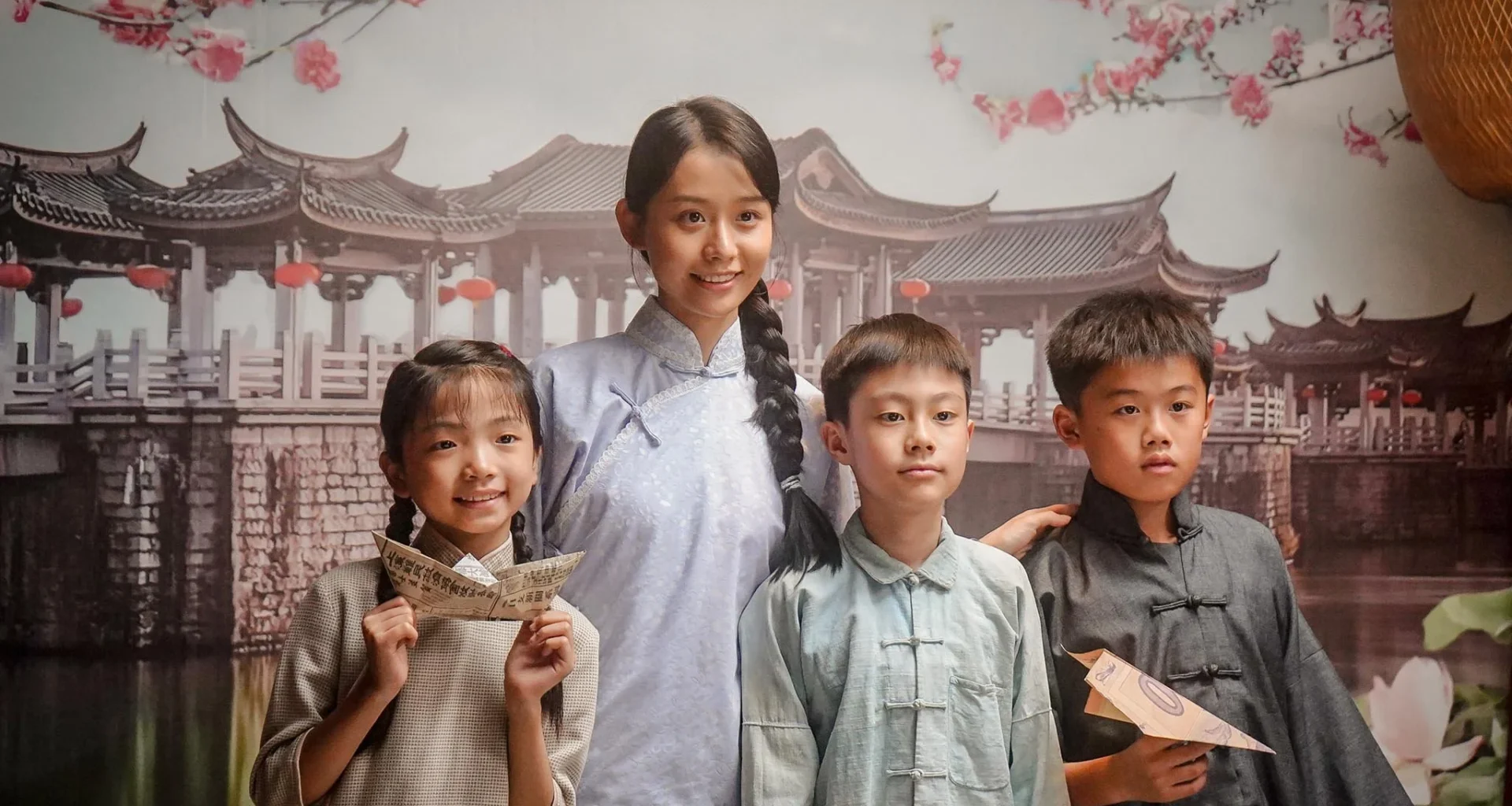
And that, more or less, is how they fall in love. But romance, as the film reminds us, comes with terms and conditions. Hers was simple: if Bhagseng wanted to marry her, he needed a bicycle. So, being a young man who was good with his hands, he did what any determined suitor might do: he built one himself, then rode her around on it. It is a charmingly old-fashioned courtship, equal parts ingenuity, devotion and the kind of romantic gesture that feels almost impossibly sweet today.
But then the story takes a far more heartbreaking turn. Den Bhagseng is forced to flee to Nanyang to evade conscription during the Civil War, leaving Sogriu behind with their three children. For years, the two remain connected through qiaopi, the remittance letters carried between Southeast Asia and southern China. This forms a lifeline that served as both international money transfer and correspondence, allowing families separated by oceans to remain, however tenuously, in one another’s lives.
Then, in 1978, the letters stop. Sogriu receives only a photograph; the accompanying letter has been lost to a typhoon. With nothing else to explain what happened, she draws her own conclusion from the image and lives with that mistaken belief for nearly four decades. It is the kind of small, devastating misunderstanding that could only happen in a story shaped by distance, weather, war and the fragile journey of a letter.
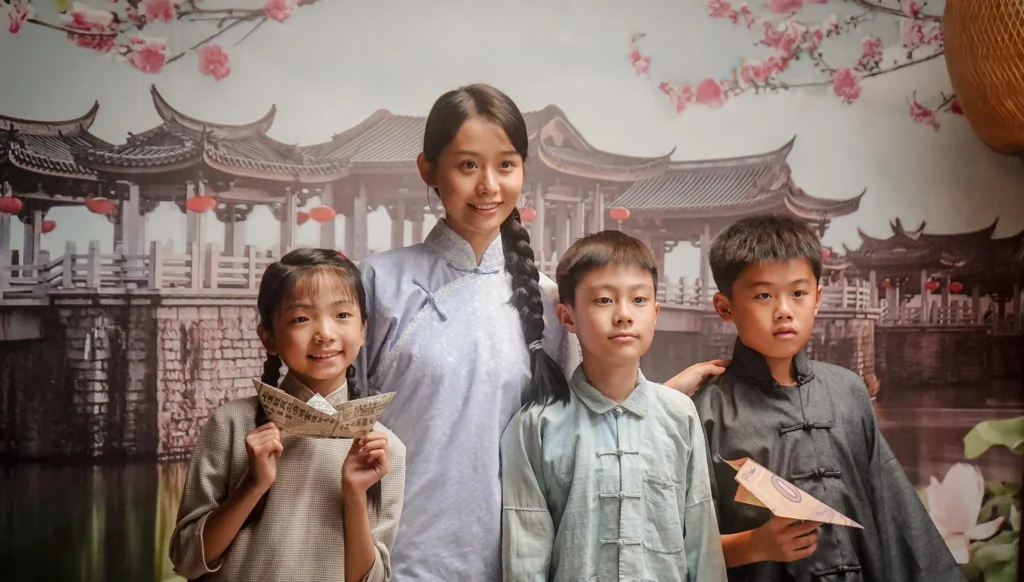
In the present day, Sogriu is elderly, as are her three children, and the past has settled into the kind of family history that everyone believes they understand. That changes when her debt-ridden grandson travels to Thailand after rumors begin circulating that his grandfather, Bhagseng, had become a wealthy man there, apparently building schools for children, establishing a new life and raising another family.
But the film wastes little time before complicating that version of events. Almost as soon as he arrives in Thailand, the grandson crosses paths with the son of the woman everyone believes was his grandfather’s mistress. From there, the story begins to peel back the decades, slowly revealing what really happened in the years leading up to that final photograph and how one lost letter managed to reshape an entire family’s understanding of the past.
In an era when cinema often mistakes scale for substance, Dear You finds its power in something far quieter: letters. More specifically, qiaopi (侨批), the remittance messages that once carried money, news and longing across oceans. The film understands that sometimes the grandest love stories are built from the smallest gestures. Its intimacy is immediate, drawing you slowly into the lives of its characters until you’re no longer watching from the outside. The Teochew dialogue only makes that world feel more lived-in, and more achingly real.
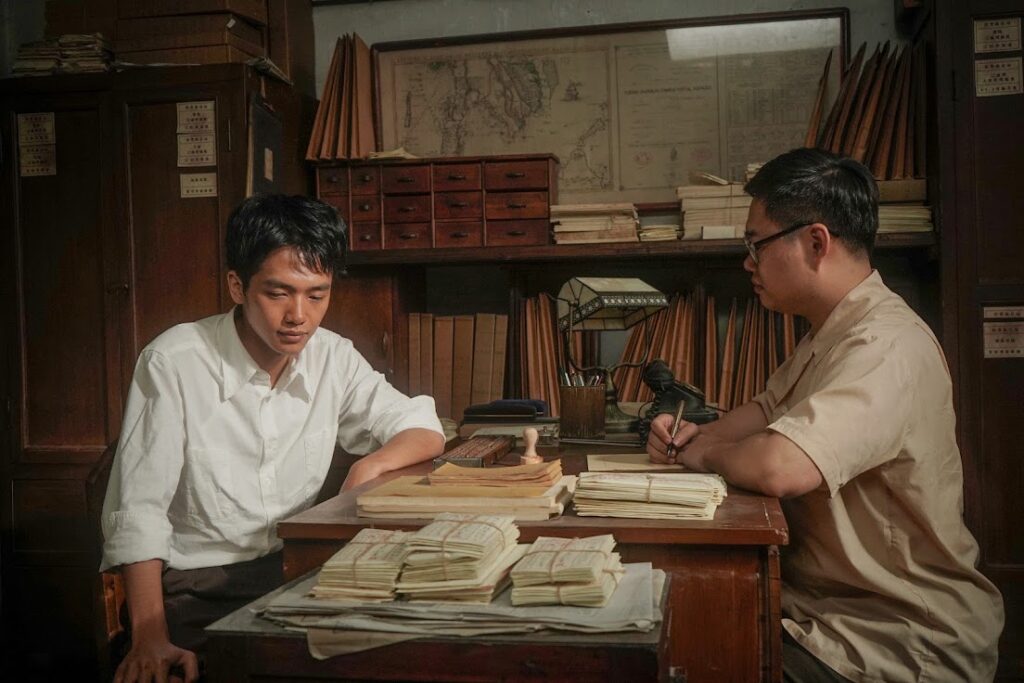
The decades-spanning narrative could easily have become unwieldy, but Dear You moves through time with remarkable ease, as though memory itself were guiding the edit. Its flashbacks never feel like detours; they emerge organically from the present, allowing past and present to bleed into one another. The effect is beautifully fluid with a story in which time feels less like a straight line than something layered and lingering.
I learned afterward that Wang Yantong wasn’t even the director’s first choice. He was considered too delicate for the part. Then Yantong did something actors rarely get enough credit for: he disappeared into the world of the film.
After joining the production backstage, he spent three months at Shantou Port, working alongside dockworkers and cycle-rickshaw riders until the physicality of the life began to show: darker skin, a rougher frame, a less polished presence. He also retrained his native Shantou accent into a more convincing Chaoyang dialect, refining not just the sound of the character but his entire manner.
By the time director Lan Hongchun saw the transformation, the question was no longer whether Yantong could play the role. He had become it.
Wang Yantong’s character begins as a rough-edged, uncertain young man, shaped as much by circumstance as survival, but gradually grows into something quieter: a man of moral steadiness. The transformation never feels manufactured. It accumulates almost imperceptibly, as though life itself has been leaving its marks on him.
Li Sitong’s Zia Lamgi offers a compelling counterpoint. Initially guarded, pragmatic and emotionally restrained, she slowly reveals a capacity for friendship and affection that feels discovered rather than scripted. What makes her performance so affecting is its refusal to resolve contradiction; hardness and tenderness are allowed to occupy the same space, sometimes within a single glance.

In a delightful bit of cinematic serendipity, How to Make Millions Before Grandma Dies Thai star Usha Seamkhum also appears in Dear You, stepping into the role of Zia Lamgi in her later years. It’s a small casting surprise, but one that adds an extra layer of warmth to a film already deeply preoccupied with memory.
Together, the performances give Dear You its emotional pulse. These characters don’t simply change because the plot demands it. They change because of one another, making their relationships feel lived-in and beautifully human.
All in all, Dear You is the kind of film that sneaks up on you, quietly tightening its grip until you find yourself smiling through the tears. Its greatest strength is its sincerity: there is no cynicism, no need for spectacle, just an earnest belief in love and the strange, enduring ways people remain connected across time and distance. By the time the credits roll, your heart may be a little bruised. But in the best possible way. Dear You doesn’t simply pull at your heartstrings. It reminds you why they’re there in the first place.

 Lakshmi





-2-300x225.png)