
 Lakshmi
There are few things more frightening than being broke when someone you love is sick. In GOD SKIN, Thai filmmaker Paween Purijitpanya takes that painfully familiar anxiety and throws it into a neon-lit arena where money buys power, technology rewrites the rules of combat, and human suffering becomes premium entertainment. The film follows Marwin (Sutthirak Subvijitra), a struggling Bangkok delivery rider whose desperation to pay his mother’s medical bills leads him into Mirage, an underground fighting league catering to wealthy spectators. He enters the ring looking for a way out. What he finds is a system that makes escaping its grip increasingly difficult.
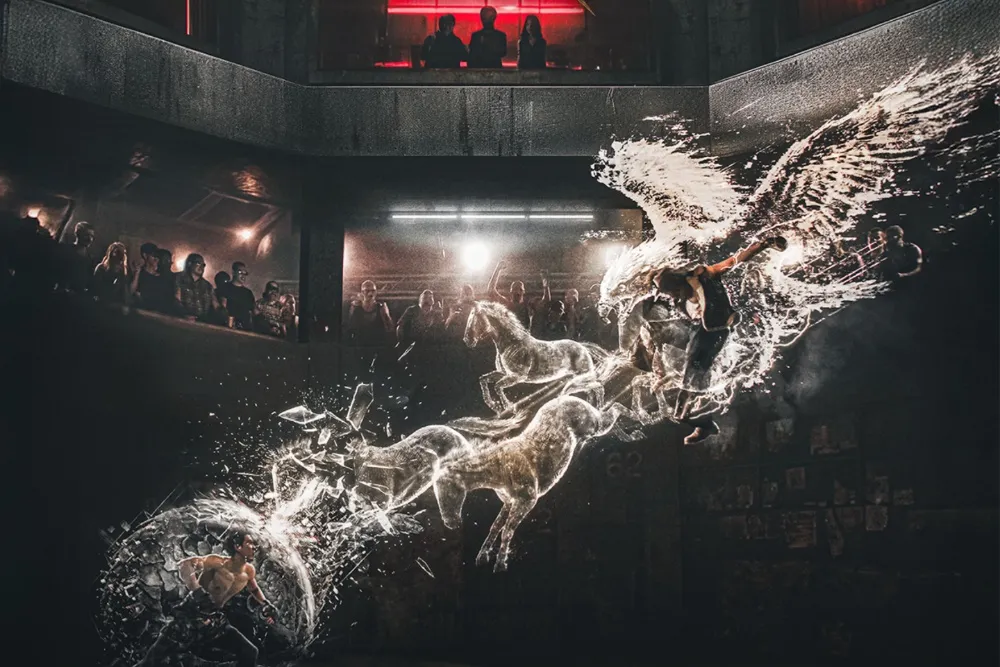
At Mirage Stadium, Muay Thai meets cyberpunk spectacle. Fighters receive nanobot enhancements through sacred tattoos, while spectators equipped with virtual-reality technology can send upgrades to their favourites, granting them extraordinary abilities inspired by animals and video games. The concept is gloriously strange, and Paween commits to it with infectious energy. With fight choreography from members of the Panna Stunt Team, known for their work on ONG-BAK, the film delivers bruising physical combat alongside flashes of digital wizardry. The result is a distinctly Thai spin on futuristic action cinema, where ancient spiritual beliefs collide with high-tech fantasies of human perfection.
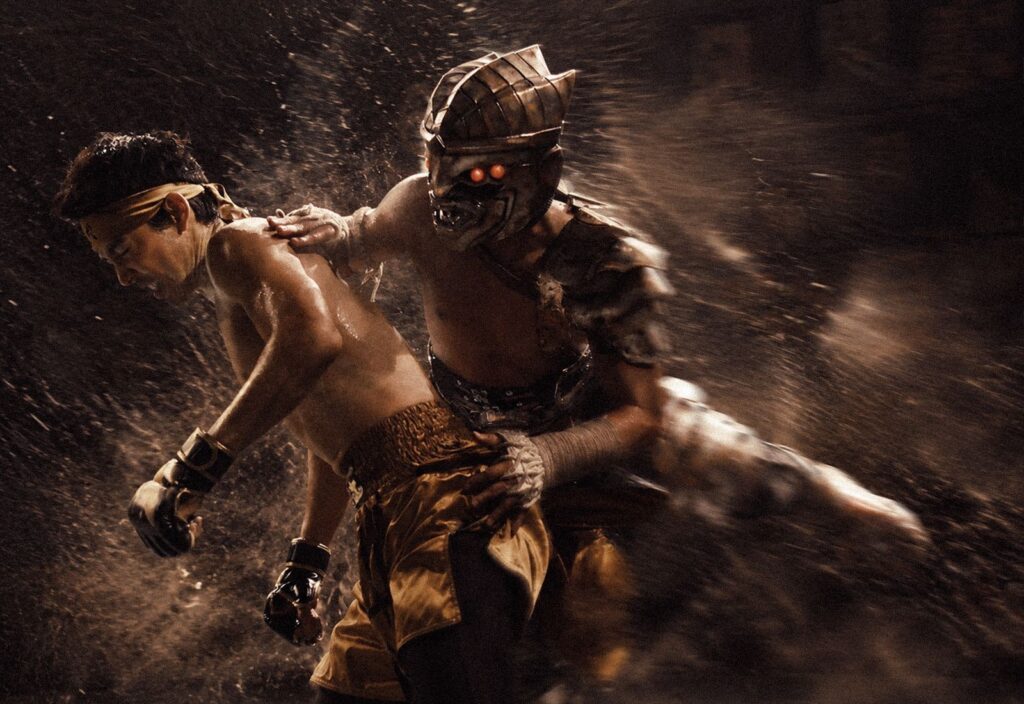
But GOD SKIN is more than an excuse to watch fighters acquire increasingly outrageous superpowers. Beneath its arcade-like interface lies a pointed examination of economic desperation and the seductive promise of upward mobility. The better Marwin performs, the more money he earns and the more reasons he finds to keep fighting. His initial motivation is noble, but ambition soon complicates the picture. The wealthy spectators can treat violence as entertainment because they are insulated from its consequences; the fighters, meanwhile, must gamble with their bodies for the possibility of a better life. It is an ugly imbalance, and one that feels uncomfortably recognizable outside the movie’s futuristic arena.
Paween, whose previous work includes the horror anthology 4BIA and the sci-fi thriller Ghost Lab, knows how to make the familiar feel unsettling. As the film progresses, its colourful spectacle gives way to body horror and darker technological paranoia. The nanobot enhancements that promise liberation begin to suggest another form of control, and the boundaries between entertainment, exploitation, and reality become increasingly unstable. The third act takes some audacious conceptual turns, even if its reality-bending revelations occasionally leave the emotional impact less sharply defined than the ideas themselves. Still, the film’s willingness to take risks is part of its appeal.
What makes GOD SKIN compelling is its refusal to separate its thrills from its anxieties. The fights are inventive, the world-building is delightfully eccentric, and the social commentary gives the spectacle something substantial to chew on. Paween is interested in what happens when technological progress outpaces our capacity to make society more humane. He also explores how easily the promise of freedom can become another mechanism of control. GOD SKIN may leave a few questions hanging, but it lands a final, unsettling punch: sometimes the most dangerous game is the one that convinces you that playing is your only choice.
Watch God Skin at the Toronto Reel Asian International Film Festival on November 19 at 7:00 PM at the Innis Town Hall.
Tickets are available here. The 30th Toronto Reel Asian International Film Festival runs from November 11 to 21, 2026, with selected feature films and all shorts available online across Canada from November 16 to 29, 2026.


 Lakshmi