-2.png)
 Lakshmi
Lily Franky is one of Japan’s most distinctive and versatile screen actors, known for performances that can move effortlessly between tenderness, humor, eccentricity, and darker emotional territory. He earned international recognition for his role in Hirokazu Kore-eda’s Shoplifters (2018), which won the Palme d’Or at Cannes, and has appeared in films including Like Father, Like Son, Our Little Sister, The Blood of Wolves, and The Naked Director. A prolific writer and artist as well as an actor, Franky has built a career around characters that often resist easy categorization.
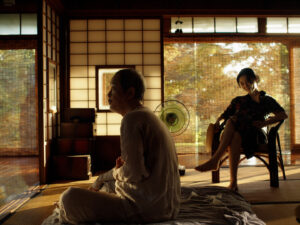
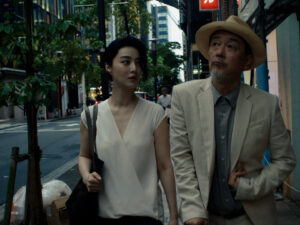
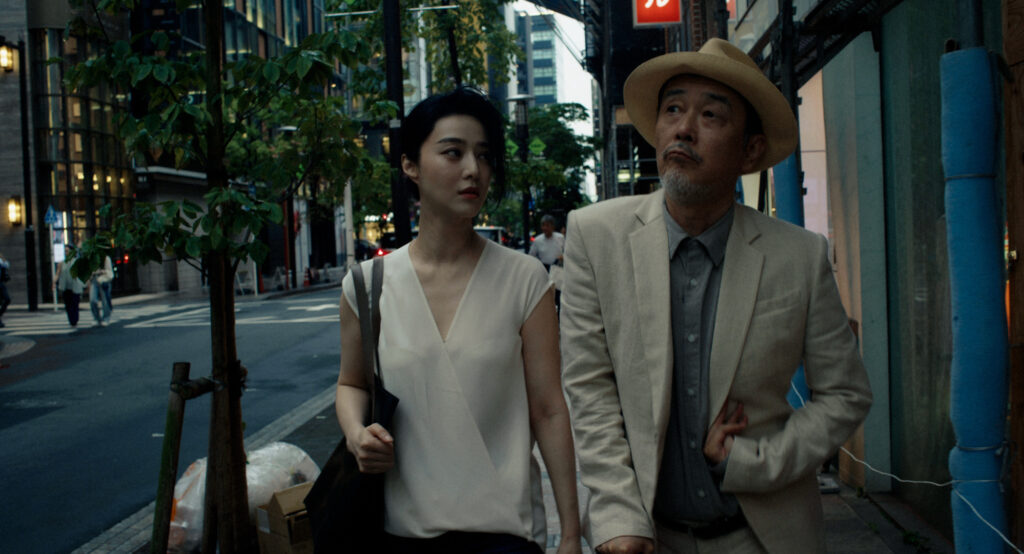
In Wayne Wang’s The Diary of a Mad Old Man, Franky takes on Utsugi, an aging businessman whose fascination with a much younger woman develops into an obsessive relationship with desire, mortality, and his own physical decline. Adapted from Junichiro Tanizaki’s provocative 1961 novel, the film explores the uneasy intersection of sexuality and aging, asking what happens to desire when the body begins to betray it. Alongside Fan Bingbing, Franky brings a mixture of vulnerability, humor, and unsettling innocence to a character whose desires are at once deeply personal and universal.
During the Toronto International Film Festival, Franky sat down with One Lash Shot to discuss Tanizaki’s enduring influence, the complicated humanity he found in Utsugi, working with Wang and Fan Bingbing, and the unexpectedly intimate process of bringing the character to life.
What was your relationship with Tanizaki’s work before this film? Had you read The Diary of a Mad Old Man before Wayne approached you, and what was your first reaction to the novel—and to the idea of bringing Utsugi to life?
Tanizaki is a very famous writer whose work can be found in every school textbook. There have also been many film adaptations of Tanizaki’s stories over the years. Whether it’s a film or a book, his work is very popular in Japan.
You’ve played such a remarkable range of fathers — from Shoplifters to Renoir — but Utsugi in The Diary of a Mad Old Man is such a radically different kind of father figure. What made this character irresistible to you?
In my mind, on the contrary, the role in Shoplifters was actually quite different. Utsugi, although some of his writing was cut by the editor, still does writing work, and I’ve been writing in Japan for a long time, so unexpectedly, I felt that I had more in common with Utsugi than I did with my character in Shoplifters.
Utsugi writes throughout the film. He writes many picture books and novels, and one of his novels is very successful in Japan. In that sense, I think his role is quite similar to mine.
So, in that way, the role of Utsugi felt very personal to me.
Yes, because you yourself are a writer.
Yes, exactly.
You’ve inhabited some darker, more complicated characters in The Naked Director and Million Yen Women. Did those roles prepare you in any way for Utsugi, or did this character require you to approach that darkness differently? And did playing those earlier roles give you a certain freedom when it came to exploring a character whose desires and morality are so difficult to pin down?
Those roles were very complicated, so I thought perhaps they were somewhat close to Utsugi’s role. Utsugi, in the original story, is more than ten years older than I am.
In that sense, I thought about Thanatos. Thanatos is death, and death and life exist very close to each other, side by side. So, it wasn’t only about the appeal of life; I also had to be conscious of the fact that death exists alongside it.
Utsugi’s character is about ten years older than I am, and I think he exists very close to the idea of Eros and Thanatos. It’s not only about Eros or desire—he is constantly thinking about death. In this world, he has to confront that reality.
Wayne has described Utsugi as having a kind of “cynical innocence,” while you’ve said you saw him as “cute.” What did you recognize in him that made you approach the character that way? His desire can be extreme and deeply uncomfortable at times—how did you find the human vulnerability beneath that obsession, and what allowed you to empathize with him?
Because it’s innocent, you know? He explained the role to me that way: if you approach something innocently, it can become very ironic.
For this role, more than the text or the novel itself, I thought about what happens when a living person actually embodies Utsugi. He could easily become a disgusting or lewd character. But I don’t think Utsugi’s actions are simply about being lewd. It’s about human sexuality and human behavior.
It’s not really a story about one old man. The sexuality of an older man is something that may not be accepted easily in any country, but it happens to everyone. I thought, yes, that’s part of what makes the character interesting.
Actually, Utsugi himself is a very eccentric person. But he isn’t just this particular character. For people who are aging, he represents those kinds of complicated feelings. In Japan, people aren’t always very kind toward older men who express erotic desires, but Utsugi feels very strongly about his own desires and sees them as something generous and human. That’s why I was able to understand the character.
In a way, he is like a teacher of humanity.
As for the physically demanding scenes, Wayne is a director who talks a lot. He would say, “The scene we’re scheduled to shoot today is like this. How can we change it to make it better?”
For example, if Ms. Fan Bingbing was dressed in a certain way, the next fantasy scene, if we left it as written, might have looked like a conventional, polished movie. So, we shot a scene that deviated from the original story.
Wayne was careful not to make the film too polished or too conventional. Many scenes were eventually cut, but some of those more unexpected moments remain in the film.
The role asks you to go to some pretty unconventional and physically demanding places. Was there a moment when Wayne asked you to do something that surprised you—or pushed you further than you expected to go as an actor?
Wayne talks to me a lot. He’ll ask me, “For today’s scene, how can we make this scene better?”
For example, there’s the scene where Bingbing is dressed as a man, and the eel fantasy scene. I thought, “If we do it like this, it will be a good movie.”
But if we made the film exactly as it was written, it would just be a good film. Wayne didn’t want to make a simple, conventional “good film.” That’s why he suggested trying something different.
The eel?
Yes, the eel scene. So, I thought about it and made sure that it wouldn’t become a too polished or conventional movie. But the scenes where everyone was going, “Oh, oh,” were cut.
There are more scenes that are omitted?
Yes, more scenes.
You should have put it in the final cut. It should have been there.
There are many cuts which doesn’t exist anymore.
You’ve mentioned doing things that weren’t originally in the script, including some extremely unconventional physical scenes. How much freedom did Wayne give you to explore Utsugi’s sexuality?
Fan Bingbing and I both think that this film is a kind of Wayne’s fantasy on Tanizaki. So, every time we asked Wayne how to do a scene, we followed his direction. For example, in the opening scene, Utsugi is masturbating a bit. Wayne wanted a masturbation scene; he wanted to shoot it that day, but the way Wayne worked it out, it just couldn’t be done. It was very detailed. This time, I really thought it was a shared vision between me, Bingbing, Wayne, and Tanizaki. It’s a runaway fantasy—Fan Bingbing’s, his, and this footage is like Tanizaki’s fantasy.
I really did it—I actually licked her feet. Wayne gave me very precise instructions. He directed me exactly where to start and where to lick, saying, “You must lick here, and then lick here.” That is probably Wayne’s personal sense of taste coming through. Maybe it was a direction he already had mapped out in his head—he preferred it like this or like that. So, it took a very long time to shoot and put these three scenes together.
Additionally, Bingbing is a very shy person. In that scene, her character is supposed to be drunk, so that’s why we drank sake on the set before shooting.
What was it like working opposite Fan Bingbing, particularly given the very different cultural and professional backgrounds you both bring to the film?
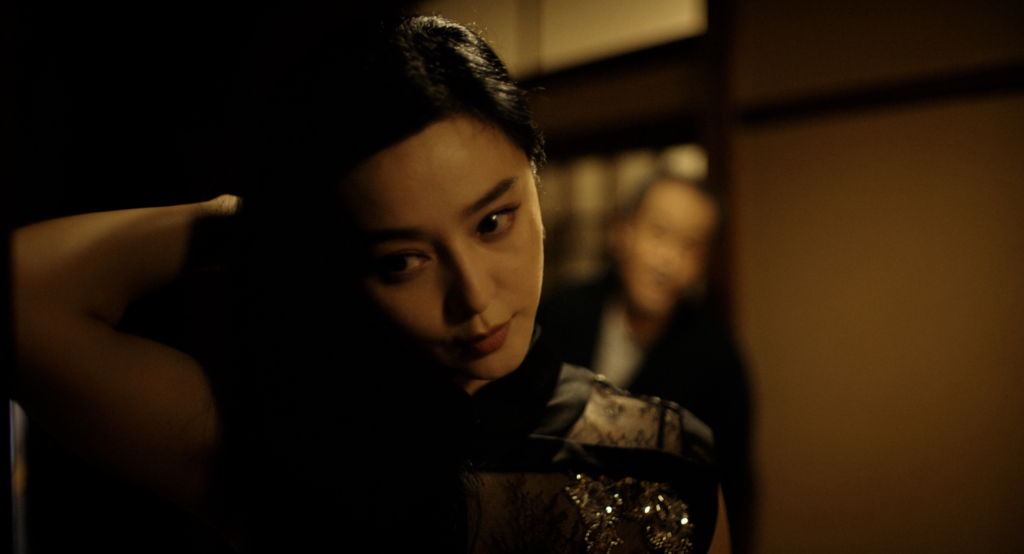
Bingbing is a very special person in the Chinese film industry. She’s a big star in the entertainment industry as a whole. I mainly work in the subculture, making very inventive films like this, so we come from very different backgrounds.
But when you actually work with her, she’s very easy to work with as a partner.
Also, Bingbing has a great capacity to fulfill a director’s demands. She’s been able to play many different kinds of roles.
Maybe that’s why she has such a good personality.
I had a question regarding one scene. The image of Buddha’s feet is engraved on the tomb, allowing the dead to follow Buddha’s path. Is that something that is common in Japanese culture? How did he perceive Utsugi following Susu’s path?
It’s not something that Japanese people commonly think about. But in the original script, there was nothing about the Buddha’s foot. It is included in Tanizaki’s novel, though, so it was my idea to include it in the script. I suggested to Wayne that it was necessary.
But it’s not simply a perverted idea of wanting to sleep under the Buddha’s foot. There’s a lot of respect and tradition associated with it. So, he wants to sleep under the Buddha’s foot.
Looking back at Utsugi’s journey, what do you think he is ultimately searching for — desire, connection, youth, or something else?
The image of the grandfathers and grandmothers reflects how young people think about old people. When we read about Utsugi, especially when we’re young, we tend to think of old men and old women in a certain way. We think Utsugi is a product of the imagination of young people: old people are like this; old men are like that.
But until the day they die, old people are still men and human beings. I hope that’s reflected in the novel.
How do young people think about old people? In reality, though, old people still have desires. Maybe that’s what this film shows. Old people are different from the conventional image we have of them. They still have some kind of desire to live. They don’t want to die.
In Buddhism, the goal is to overcome desire—to make desire disappear. But no one can completely achieve that. In reality, nobody can eliminate all desire. You can’t escape from the karma of desire until you die.
The seniors around me are all a little like Utsugi. Basically, there are many people who still have desires until the very end. There aren’t many people who are exactly like Utsugi in this novel, of course.
Describe the film in one word.
It’s a film about a pervert. But in reality, it’s a film about a very familiar self.
[Author’s Note: Lily-san, I can’t wait to see all the complex and fascinating roles you’ll take on in the years to come—and, of course, many more of my favorite Japanese TV shows! Thank you for everything you write, everything you create, and every character you bring to life.]


 Lakshmi