 Lakshmi
What does desire look like when the body begins to fail?
That question sits at the uneasy heart of Wayne Wang’s The Diary of a Mad Old Man, an adaptation of Jun’ichirō Tanizaki’s provocative 1961 novel. On paper, it is an outrageous premise: an aging widower, physically weakened by a stroke, becomes increasingly obsessed with his much younger daughter-in-law. Yet Wang’s film is less interested in the shock value of that desire than in what it reveals about aging, loneliness, mortality and the stubborn human need to feel alive.
The result is an unexpectedly melancholy film—occasionally funny, frequently uncomfortable and far more tender than its premise initially suggests.
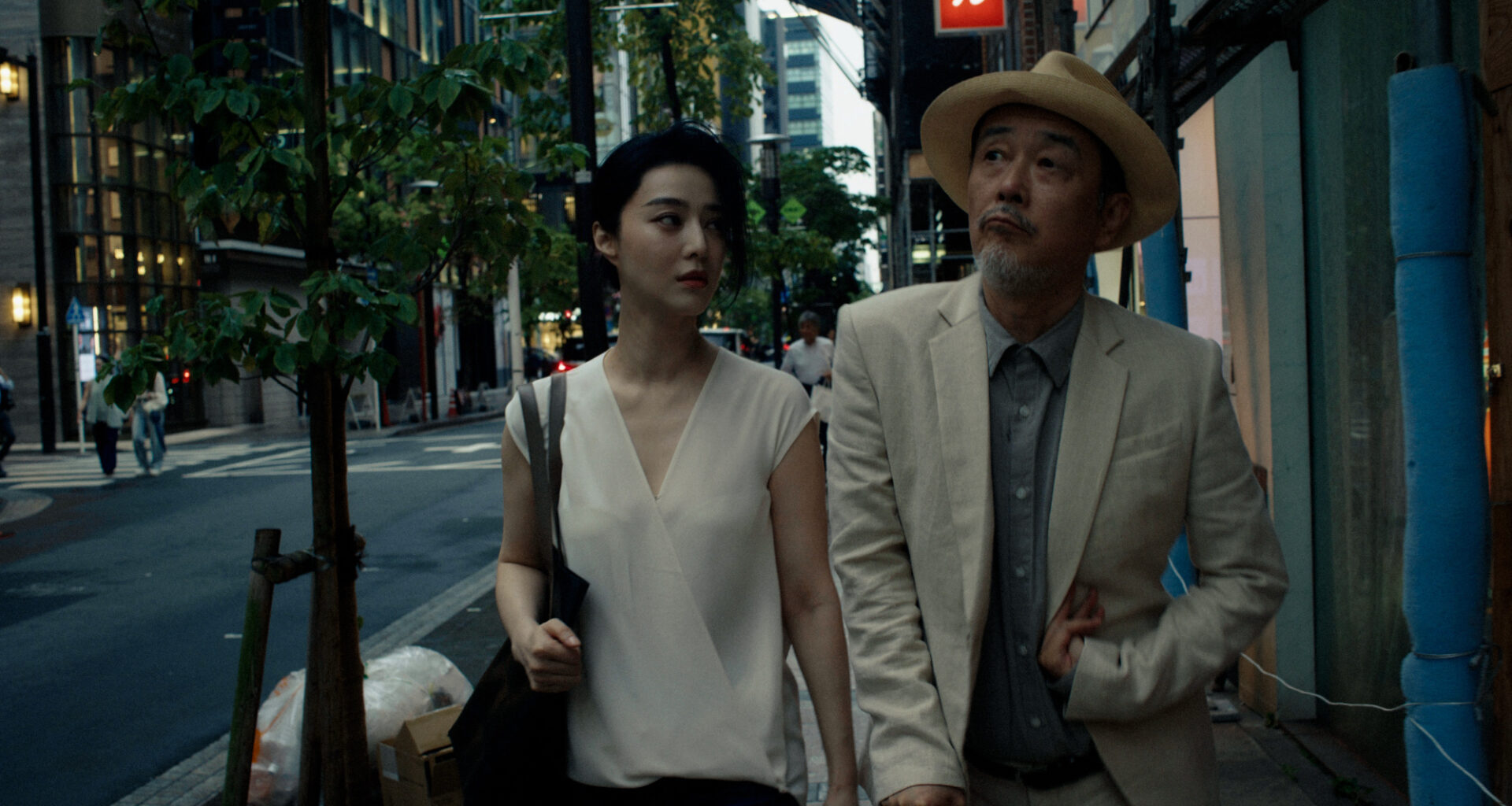
Utsugi (Lily Franky) is a 69-year-old retired intellectual whose life has been drastically altered by a stroke that leaves the left side of his body paralyzed. He is increasingly dependent on the women around him, particularly his sister-in-law Hana (Yūki Kudō) and his Chinese-born daughter-in-law Susu (Fan Bingbing). When the rest of the family leaves for a summer holiday, Utsugi chooses to remain at home, with Susu staying behind to care for him.
That arrangement becomes the catalyst for his increasingly elaborate fantasies.
A glance, a gesture, a shower, an apparently casual moment of physical proximity—Utsugi begins to interpret everything Susu does through the prism of desire. His attraction becomes the organizing principle of his increasingly inward world. Wang frequently places us inside Utsugi’s consciousness through narration, allowing us to experience not only what happens but how dramatically he transforms ordinary events into erotic possibilities.
The film announces its preoccupation immediately. In the opening sequence, Utsugi attempts to masturbate at his desk, only to find that his aging body will no longer cooperate with him. It is an unusually blunt introduction, but also an important one. The scene establishes the film’s central contradiction: Utsugi’s body is deteriorating, yet his appetite for life has not disappeared.
If anything, it has become more urgent.
Tanizaki wrote the original novel after suffering a stroke himself, turning physical decline into a brutally self-conscious examination of appetite, vanity and mortality. Wang, now in his late seventies, has approached the material from his own perspective on aging. His Utsugi is therefore not simply a literary character transported into the present. He becomes a vehicle through which the director can examine the persistence of desire when youth, physical strength and social authority have begun to disappear.
Lily Franky is exceptional in the role because he refuses to make Utsugi easy to categorize. He can be vulgar, selfish and deeply inappropriate, but he can also be funny, lonely, vulnerable and almost childlike. His physical performance is particularly effective. Franky communicates Utsugi’s paralysis without turning it into a theatrical caricature, allowing the character’s physical limitations to remain an everyday humiliation rather than a dramatic gimmick.
There is something almost adolescent about Utsugi’s fixation. He becomes jealous, overexcited and desperate for attention. Yet underneath the comedy is something much sadder: an elderly man discovering that his desire has outlived the version of himself who once had the physical and social power to act upon it.
Wang’s greatest achievement is that he does not ask the audience to forgive Utsugi. Instead, he asks us to understand him.
That distinction becomes particularly important in the film’s treatment of Susu.
Played by Fan Bingbing, Susu is never simply the object of Utsugi’s gaze. She is aware of his fascination with her and appears to understand exactly how much influence she has over him. Her background as a former Shanghai bar hostess suggests an intimate familiarity with masculine desire and the ways in which it can be manipulated, monetized or weaponized.
But Wang refuses to reduce her behavior to calculation.
Susu may be caring for Utsugi, indulging him, manipulating him, exploiting his attraction or developing a genuine affection for him. Often, it feels as though several of these things are happening simultaneously. Fan maintains that ambiguity beautifully. Her performance moves between sensuality and vulnerability, confidence and uncertainty, ensuring that Susu remains impossible to fully possess—even within Utsugi’s imagination.
This is also where the film complicates its potentially troubling male gaze.
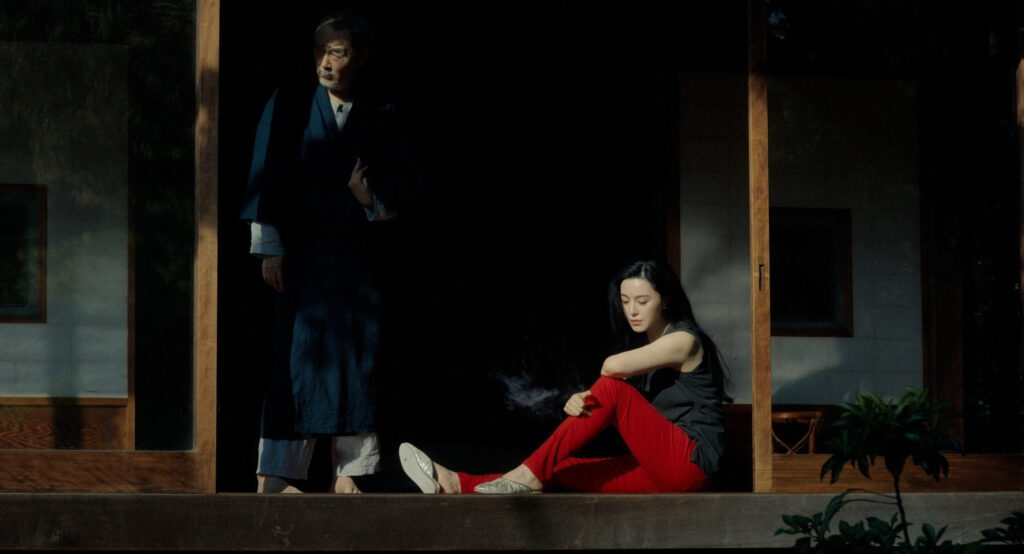
Wang has spoken about consciously resisting a purely male perspective on Susu. His camera often observes rather than dictates, favoring longer and wider shots over constant close-ups. Instead of fragmenting her body into a series of erotic images, the film frequently allows her to exist within a larger space, surrounded by the household and its other inhabitants.
That approach gives the actors room to behave rather than simply hit predetermined marks. It also creates a documentary-like quality that has long been characteristic of Wang’s filmmaking.
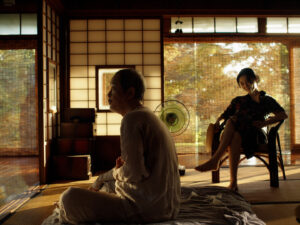
The visual language is particularly effective in the film’s treatment of light and shadow. Working with cinematographer Koichi Furuya, Wang draws on the aesthetic traditions associated with Tanizaki himself, frequently allowing faces and bodies to disappear partially into darkness. Nothing is entirely revealed—not Utsugi’s fantasies, not Susu’s intentions, and not even the emotional truth of their relationship.
As their connection develops, the camera gradually moves closer. The shift is subtle but meaningful. What begins as observation becomes intimacy, even if that intimacy never develops into conventional romance.
The family surrounding them provides another layer of tension. Utsugi’s relationship with his son Jokichi is defined by resentment and competing ideas of authority, while his relationship with Hana reveals how much of the household has been sustained by women doing the work traditionally assigned to them. The aging patriarch may still believe he controls his family, but his physical dependence increasingly exposes how little power he actually possesses.
The film’s most provocative moments therefore have less to do with sex itself than with the collapse of Utsugi’s authority.
His desires may be inappropriate, but they are also one of the few things he still feels he can claim as his own.
That is why the film is strangely anti-erotic despite its subject matter. Wang rarely treats Utsugi’s fantasies as conventional sensual spectacle. Instead, desire becomes awkward, embarrassing and sometimes absurd. A foot, a glance or a glimpse of Susu can acquire enormous significance because Utsugi has so little else left to control.
His obsession gradually becomes less about possessing Susu than about maintaining a connection to life.
This is where the film’s relationship with mortality becomes most powerful. Utsugi exists in the space between Eros and Thanatos—the desire to live and the awareness of death. His body is deteriorating, but his appetite remains. The closer death comes, the more insistently he wants to experience something.
Wang finds surprising poignancy in that contradiction.
The film also makes room for its stranger impulses. Fantasies, erotic rituals and moments of deliberately uncomfortable physicality are presented without being neatly explained or domesticated. Rather than turning Tanizaki’s novel into a conventional prestige adaptation, Wang embraces its eccentricity while relocating its concerns into a contemporary world.
The result is not always perfectly balanced. The film occasionally becomes more sentimental than Tanizaki’s colder, darker original, and its deliberately measured pace may test viewers looking for conventional narrative momentum. Some of the newly developed material can feel more contemplative than dramatically necessary.
But the film’s patience is ultimately part of its design.
Wang is not rushing toward a revelation. He is interested in watching Utsugi live with his contradictions—to observe what happens when lust, loneliness, dependency, jealousy, affection and mortality become impossible to separate.
That makes The Diary of a Mad Old Man considerably more than a film about an elderly man’s sexual fixation.
It is a film about the indignities of aging without turning aging itself into an indignity. It acknowledges that old people can be ridiculous, selfish, horny, lonely and confused while insisting that none of those qualities make them less human.
Franky understands that completely. His Utsugi is sometimes pathetic and sometimes disturbing, but he is never merely a joke. Fan, meanwhile, gives Susu enough independence to ensure that the film’s emotional center remains unstable and unresolved.
By the end, Wang has transformed Tanizaki’s provocative premise into something more existential. Utsugi’s desire is not simply a hunger for sex or youth. It is a refusal to disappear.
That may be the film’s most uncomfortable—and most moving—idea: the body can grow old, authority can disappear and death can move ever closer, but the desire to feel something does not necessarily age with them.
In Wang’s hands, The Diary of a Mad Old Man becomes not a celebration of Utsugi’s desires, nor a condemnation of them, but a portrait of the strange, stubborn humanity that survives underneath them.

 Lakshmi

-2-300x225.png)