 Lakshmi
Over the past decade, Leon Le has emerged as one of the most compelling voices in Vietnamese cinema, building a body of work defined by its emotional nuance, visual elegance, and deep appreciation for Vietnamese culture and history. Before moving behind the camera, the Vietnamese-American filmmaker worked as an actor and producer, experiences that continue to inform his sensitive, performance-driven approach to storytelling.
Le first gained international recognition with Song Lang (2018), a critically acclaimed drama set against the world of traditional cải lương opera that was celebrated for its lyrical direction and heartfelt performances.
His latest feature, Ky Nam Inn, once again looks to Vietnam’s past, transporting audiences to post-war Saigon through a tender, atmospheric romance. As the film prepares to reach the New York Asian Film Festival (NYAFF) audience, Leon Le sat down with us at One Lash Shot to discuss the inspirations behind Ky Nam Inn, the significance of its historical setting, reuniting with Liên Bỉnh Phát, collaborating with Đỗ Thị Hải Yến on her return to the screen, and why The Little Prince became an integral thread woven throughout the film.

Ky Nam Inn is set in post-war Saigon, a period that is rarely explored with such emotional intimacy. What drew you to tell a love story within this particular historical moment?
Well, first of all, I’m always drawn to love stories. And second of all, I think love stories are one of the easiest ways to draw people in. It’s kind of like a sugar-coated medicine—once you have their attention, you can hopefully, without them noticing, slip in the different layers of the true story that I want to tell.
To me, Ky Nam Inn is not so much a love story if people really pay attention and look beneath the surface. It’s more a story about what it was like for a country and its people in the aftermath of war.
I think even younger generations in Vietnam today are not familiar with this period because it is not discussed very much, and they do not get to learn about it in school. This became clear when the film was released in Vietnam in November. I saw many questions and expressions of disbelief from younger audiences, and even from people who lived in Vietnam during that time but were not in Saigon. They were completely surprised by what happened, what life was like, and the political nuances that even many Vietnamese people who lived through that period outside of Saigon were unaware of.
Were the characters and their relationship inspired by real people or personal experiences, or is the romance entirely a work of fiction?
They’re all based on people that I encountered. The character of Ky Nam, in particular, was inspired by a real person who was living underneath my unit in an old apartment building that I rented in Vietnam while I was making my first film, Song Lang. She made a living doing catering. She was in her early 50s, and the only difference was that she was very angry at the world. She was constantly fighting with the neighbors every day.
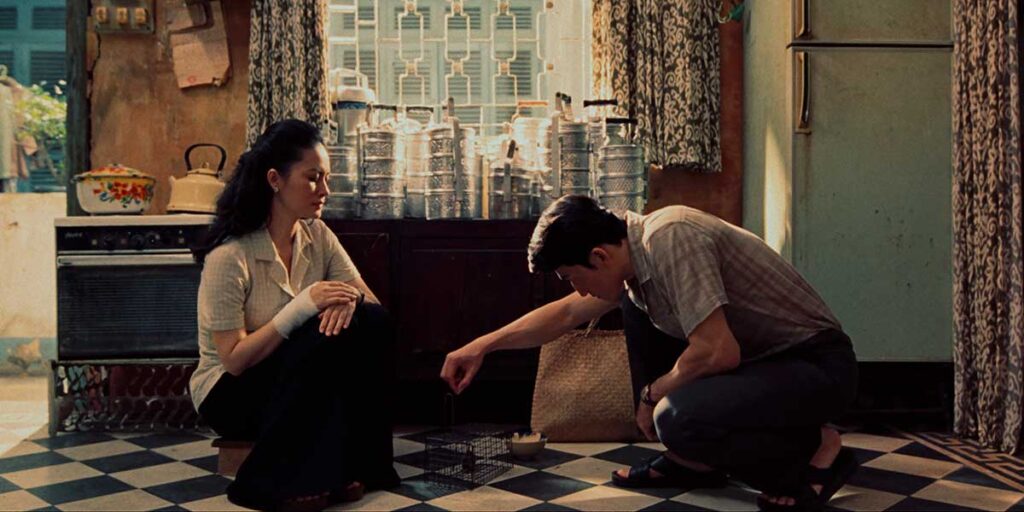
I found it interesting because, to me, cooking is an act of caring. You have to put so much—maybe not love, but a great deal of care—into that kind of work. And yet, she did this for a living while being angry at the world all the time. To overcome my own annoyance with the situation, I started imagining what could make someone so angry. She must have been deeply unhappy, but why? Was it an unhappy marriage? An illness? An unhappy childhood? Unfulfilled dreams? Whatever it was, I began creating these stories in my head.
That became the initial inspiration for the character. And, like the artist character in the film who lives above her, many of the other characters also came from people I met in that building during the time I lived in Saigon, from 2016 to 2018.
So, the guy is based on the you?
The only thing is that he is a younger artist living above this woman who makes a living doing catering. But actually, many of his characteristics were inspired by the actor I wrote the role for, Liên Bỉnh Phát, because I wrote the character with him in mind.
After the success of Song Lang, what inspired you to reunite with Liên Bỉnh Phát for Ky Nam Inn? And with Đỗ Thị Hải Yến returning to the screen in this film, what was it like bringing these two performers together for the first time?
Yes, I was actually thinking about this part for him while I was working on Song Lang. We hadn’t even finished shooting Song Lang yet, and I already thought, “You know what? I think this is going to be a great part for him.”
I saw so much potential in him as an actor, even though Song Lang was his first film ever. I knew that, given the film industry at the time, it would be difficult for him to find another role and another acting experience that would be similar to Song Lang. And because I was the one who discovered him, I felt somewhat responsible.
I felt that because of my way of working and the type of cinema and film experience I introduced him to, he might have a difficult time transitioning into different projects with other directors, especially more commercial films that dominate the industry. I also really liked him as a person—he is a wonderful person—so I felt a sense of responsibility. At the same time, he continued to inspire me, not only because of his talent but also because of his character as a human being. I thought this role would be perfect for him.
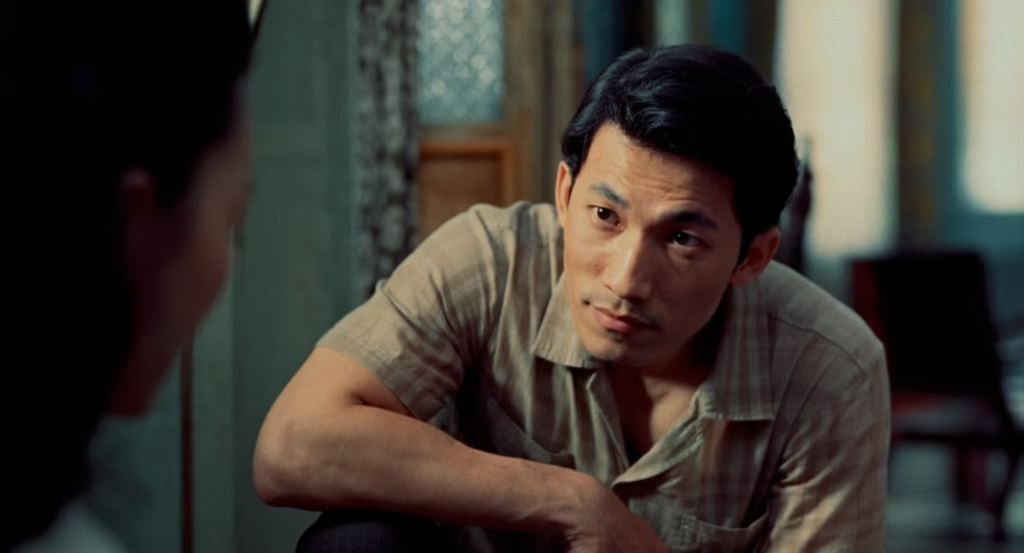
With Đỗ Thị Hải Yến, she actually was not my first choice. She was not even on the list of actresses I was considering for the role, mainly because I initially felt she was a little too young for the part.
Originally, I wanted the age gap between Ky Nam and Khang to be much larger. I imagined her being in her late 50s, and originally Ky Nam was actually in her 70s. It was not a romance at first. But then I thought, “You know what? If I make it a romance, I think it will be easier to attract the audience’s attention.” So when I transformed it into a love story, Ky Nam became someone in her mid-50s, while Hải Yến was only in her early 40s—she was 40 when we shot the film. The age gap between them was no longer as large.
There was also another challenge: Hải Yến is from the North, but she grew up after 1975, so her dialect and accent are different from Ky Nam’s. Ky Nam is also originally from the North, but she immigrated to Saigon in 1954, and that creates a significant difference. International audiences may not notice it, but for Vietnamese audiences, it carries important historical and political significance.
Hải Yến had to go through training to learn how to speak with the 1954 Northern dialect. She also took singing lessons to lower her vocal pitch. After a long process of searching for the right person to play the role, I met with Hải Yến, we had a long conversation, and I decided to give it a try. During casting, I put her and Phát together, and I felt they were a perfect match. I think she did a wonderful job.
Khang arrives in Saigon to translate The Little Prince. Why did you choose that novel, and what does it symbolize within the larger narrative?
You know, my parents’ generation all went to French schools in Vietnam, and The Little Prince was basically considered one of the required books they had to read as part of their education.
So The Little Prince was a very familiar book for my parents’ generation, especially those who received a French education. When we realized that this book could represent that generation of Vietnamese people, particularly those from Hanoi in 1954 who immigrated to the South, it became very meaningful.
There was also a parallel between the journey of The Little Prince and Khang’s journey. He arrives at this apartment complex and meets all of these different characters, just like The Little Prince travels to different planets and encounters different people. Through those encounters, he gains a deeper understanding of life, love, and the world.
I thought it was the perfect book for the story. Actually, in the beginning, we were also considering Les Misérables, which is another very well-known book in Vietnam. But it is such a large and expansive story, and we knew that Khang’s time at the apartment complex would be relatively short. The Little Prince felt like a much more fitting choice for the film.
Much of the relationship between Khang and Ky Nam is communicated through silence, lingering glances, and everyday rituals rather than dialogue. Was that emotional restraint always central to your vision for the film?
You know what, it’s never my intention to dictate a certain style for the film I’m going to make. It really comes from the characters and the story itself. As the story unfolds, it tells me how it needs to be told.
I never set out to make a slow film or a film with very little dialogue. It’s just that, as I got to know these characters more and more throughout the writing process, I realized there were things between them that they didn’t need to say—or perhaps couldn’t say.
That’s how the tempo of the film, the rhythm of the characters, the way they behave, and the amount of verbal exchange naturally developed. It made sense for them to communicate that way. It was never something I decided from the beginning.
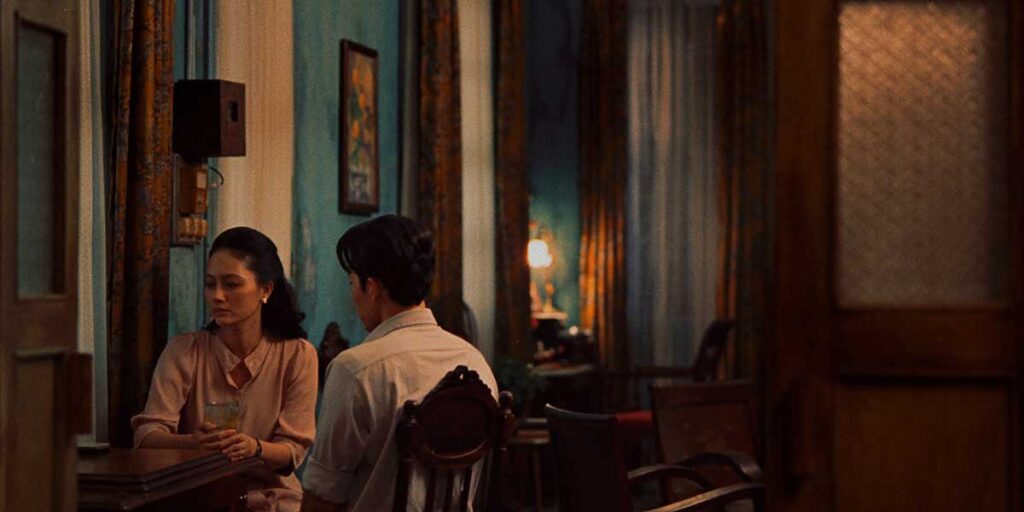
Of course, I do have certain rules for myself. I’m not really drawn to films that are overly talkative. One of my personal rules is that if a character can express what they want to say in fewer than two lines of dialogue, that’s the golden rule for me.
Then, after shooting the film, when you go back into the editing room, you often realize that a lot—sometimes more than half—of the dialogue you filmed doesn’t need to be there. So I would remove it from the final edit because, of course, when you’re looking at the script, you can’t always imagine how powerful a facial expression or a person’s eyes can be compared to words.
Once you see the footage, you realize, “She doesn’t need to say that. He already understands just by looking at her.” And that’s when you begin trimming the dialogue even further.
Every filmmaker has a scene that encapsulates what their film is truly about. For you, which scene represents the heart of Ky Nam Inn, and why?
There are many challenging scenes because the film explores quite a few themes. But for me, the most difficult scene to shoot and edit was probably the kissing scene.
It was very difficult to find the right balance because I was always afraid it would become too cheesy. I had to constantly ask myself: How much is too much? Is the staring long enough? Is it too intense? Is the kiss too long or too short? Is the music too sentimental? Is it too emotional? Does it even need to be there? That was the moment where the film could easily cross into melodrama, which is something I always try to avoid.
I also had to go back and forth with the composer a lot on that scene. The first instinct is to bring in music as they walk toward each other and kiss, creating that emotional climax. But at the same time, we knew the audience also wants that moment of release—the satisfaction of finally seeing them kiss. Trying to find the balance between those two feelings was quite challenging for me.
If you had to describe Ky Nam Inn in one word, what would it be?
Stillness. I think stillness is something that most people would agree is one of the defining qualities of the film. I’m not sure whether they like it or not—they might even hate that stillness—but I think it also represents how I feel when I look back at that period in Vietnam.
At that time, the country was still under the US embargo. We were essentially living in a bubble. We had very few connections with the outside world. We were alone, isolated.
But within that stillness, there were still conflicts. At the same time, 1985 was a period of regulation and restructuring. Yet even during that quiet and uncertain time, people still found ways to care, to love, and to dream. Everything had to exist within that stillness. You weren’t allowed to be loud about what you wanted, what you dreamed of, or what you hoped for.
Even in pain, you weren’t allowed to scream.
Hopefully, I was able to capture that feeling in the most romantic way possible. If I have to describe a style or a way I see things, I think that’s how I view life: through a lens of romance, even when looking at pain and misery. But that’s simply my way of looking at the world.


 Lakshmi




-2-300x225.png)